A silica gel container for the middle of the filament spool
Filament absorbs moisture from the air. Wet filament oozes, strings, leaves a rougher surface and weaker layer bonds. That is why dried spools are stored in an airtight box or bag together with a desiccant, usually silica gel.
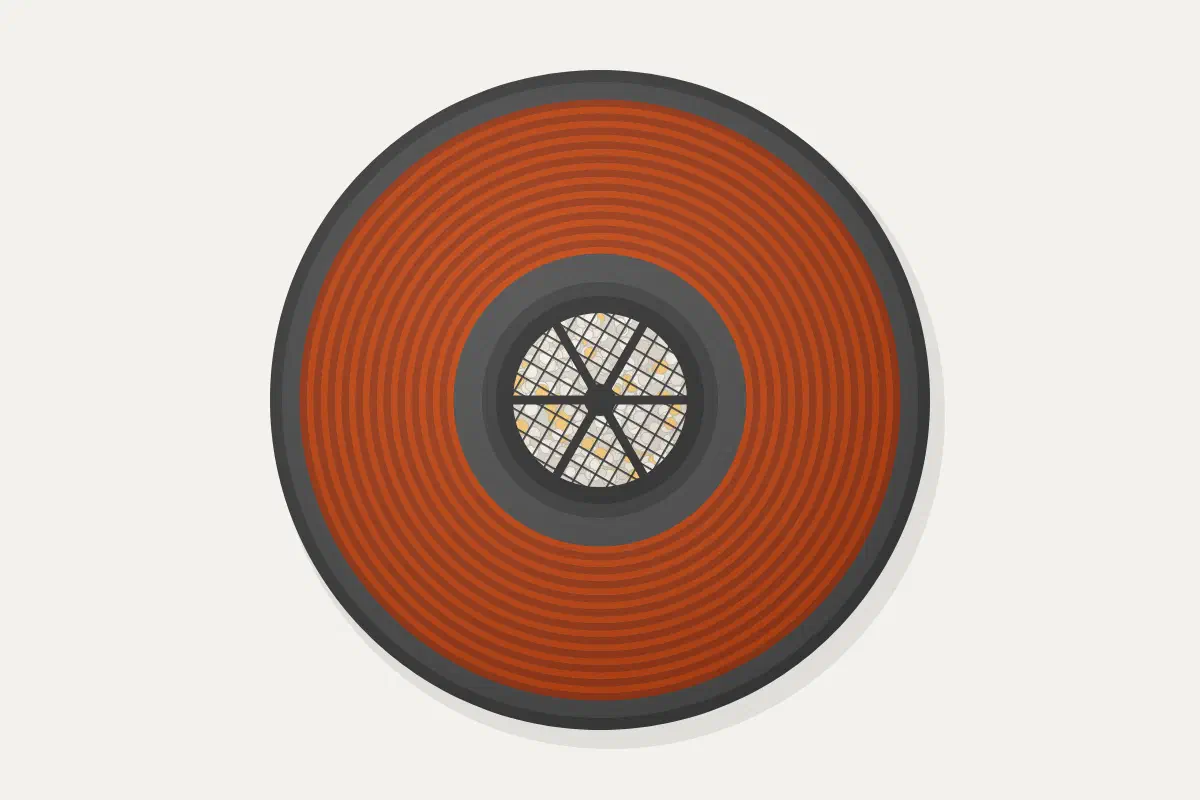
The High Performance Spool Desiccant Container Holder by Silvercell on MakerWorld answers the question of where to put the silica gel: in the hollow middle of the spool. The container is a cylinder with dense mesh walls, and its open-spoke ends also center it in the spool, so air flows through the whole core and through the spool.
It was released in March 2025 and has over 15,000 ratings and reviews. The figures below come from the designer’s description of the model, which also has the photos, print profiles and test details.
Two versions
- High Flow (HF) has three internal towers. More of the silica gel is exposed to the air, so it absorbs moisture faster and dries about twice as fast as the HC version. It suits spools that are used and dried often, in a filament dryer, an AMS 2 Pro or an AMS HT.
- High Capacity (HC) holds more silica gel and is easier to fill and empty. It suits long-term storage in a box or bag.
For a Bambu Lab spool the designer gives these amounts of dry silica gel:
| Core | HF | HC |
|---|---|---|
| Standard | ~52 g | ~68 g |
| Large | ~68 g | ~88 g |
| XL (Sunlu Gen 1 and 2) | ~75 g | – |
Wet silica gel weighs 20–30 % more.
Core size and spool width
The core is chosen by the inner diameter of the spool:
- Standard for 50–63 mm. It fits the widest range and leaves the most air around it.
- Large for 55–63 mm, with a narrower gap to the spool (1.25 mm) and more silica gel. It fits most 55 mm spools, Bambu Lab included.
- XL for 60–75 mm, such as Sunlu Gen 1 and 2 and older JAYO spools.
With a separate ring, Standard and Large also fit spools with a 63–80 mm inner diameter.
The length is chosen by the inner width of the spool; the print profiles are labelled with ranges such as “62–69 mm”. The designer test-fitted 28 different spools, from Bambu Lab, Sunlu, eSun and Polymaker to Prusament, listed in the model description. Most 1 kg spools with a 55 mm hole take the 62–69 mm version.
Mesh
There are three mesh sizes, by the size of the silica gel beads:
- standard for beads larger than 2 mm,
- fine for beads larger than 1.5 mm,
- ultra fine for beads larger than 1 mm.
Damaged or small beads can fall through the standard mesh. With indicating silica gel (which changes colour), a finer mesh shows the colour less well.
Printing
The key point: the mesh is not in the 3D model. It is made by modifiers and settings in the designer’s 3MF profiles. Printed from the STL without them, the container has no mesh. So the designer recommends:
- printing from the designer’s own 3MF profiles in an up-to-date Bambu Studio, or from the Bambu Handy app,
- a 0.4 mm nozzle and 0.2 mm layers,
- not moving parts by hand on the plate, since that moves the modifiers too,
- a clean bed and dry filament, which decide how well the thread fits.
For printing from STL in another slicer, the designer lists the settings that produce the mesh:
- 4 wall loops,
- 0 top and 0 bottom shell layers,
- 40 % sparse infill for the standard, 55 % for the fine and 42 % for the ultra fine mesh,
- triangles infill for the standard and fine mesh, rectilinear for the ultra fine one,
- “Only one wall on top surfaces” disabled, and the brim if needed.
The modifier parts (core_mesh, cap_mesh, core_mod, end_mod) are then left out.
Material
The material depends on where the container will be dried:
- PLA or PETG are enough for a container that stays in a dry box or bag.
- ABS, ASA or PC are needed if the container is dried in a filament dryer, since PLA and PETG can deform above their heat deflection temperature. ABS, ASA and PC are printed in an enclosed printer.
- PA6-GF, PA6-CF, PAHT-CF or PET-CF are the designer’s choice for advanced users drying in an oven. Exposed fibres should be scrubbed off under water after printing, with gloves on, so the thread does not bind.
Transparent filament is a good choice for indicating silica gel.
The designer load-tested the container with 10 kg without cracks. Its strength still depends on good layer adhesion, so on temperature, speed and cooling.
Filling and drying the silica gel
- Before filling, check that the cap screws on easily.
- Fill to the top but do not overfill; gentle tapping settles the beads. The cap must screw on all the way, or it can work loose and spill the gel.
- For the HF version, tilt the funnel and container by 30–45° so the beads do not bounce out.
- Dry the container out of the spool, in a dryer at 65 °C or more, if it is printed in a material that takes the heat. In the middle of a spool the air is 10–20 °C cooler and barely moves. For drying in a dryer or an AMS, the designer also made a spool that holds up to seven containers.
- For faster drying, pour the silica gel into a dish and dry it in an oven or microwave, but not above 120 °C, which damages the gel.
- After drying, let the container cool before putting it back in the spool. Warm gel still gives off moisture, and the container tightens in the spool as it cools.
Where to store spools
The designer also compared storage options, by how long 60 g of silica gel lasts in a room above 60 % humidity. The resealable aluminium foil bag the filament comes in did best, at over two years. Next came a round polypropylene container with a tight lid (over a year) and a cereal box (about six months). Ordinary zip bags, filament dry boxes and vacuum bags lasted 2–4 months. For moisture-sensitive filaments such as nylon, those times should be halved.
Add-ons
The same model has extra parts:
- an end ring that holds a round hygrometer,
- an adapter ring for 63–80 mm spools,
- a holder for the RFID tag from an empty Bambu Lab spool,
- two funnels for filling,
- a tool for opening the cap.
In short
The model is well thought out and thoroughly tested, and its many sizes fit almost any spool. Just print it from the designer’s profiles, since without them there is no mesh. The files are free on MakerWorld, under a license that allows printing for your own use but not sharing the files on.