A drying spool for silica gel containers in the AMS and filament dryers
In the previous post we looked at a silica gel container for the middle of the filament spool. The silica gel in it takes up moisture over time and has to be dried. Pouring the beads into a dish and back is slow, and the container does not heat well when it stays inside a spool in the dryer.
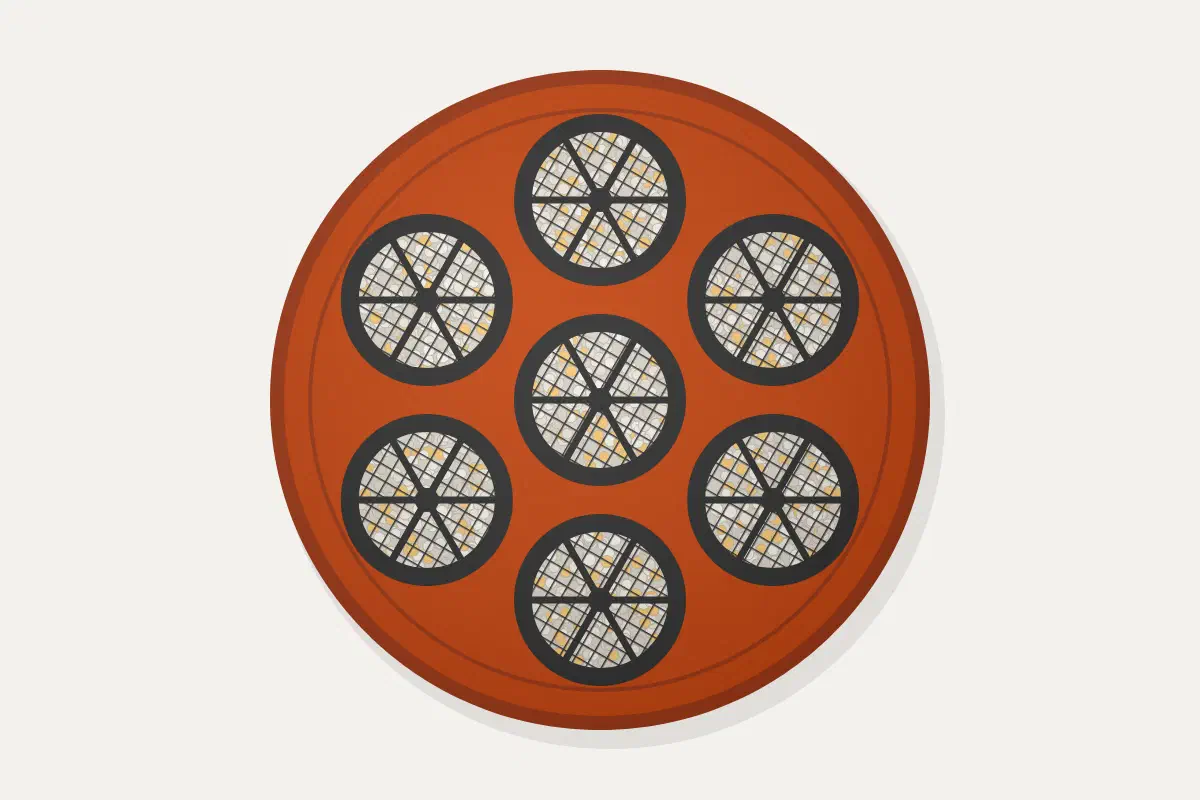
So the same designer, Silvercell, made the Silica Gel Container Drying Spool: a spool that carries up to seven containers instead of filament. Put it in an AMS 2 Pro, AMS HT or filament dryer and the containers dry without being emptied. The model was released in June 2025. The figures below come from the designer’s description of the model, which also has photos and a short assembly video.
The spool works only with the containers from that model, not with other desiccant containers.
How it is built
- Two side plates with holes for the containers. The containers in the outer holes hold the spool together, and the center container joins the two halves.
- The outer holes have clips that grip the container, so the spool does not fall apart while you carry it.
- Taken apart, the spool is only 14 mm thick and easy to store.
- The width is not fixed: containers made for spools of different widths fit, as long as they all have the same length.
- The containers hardly block one another, so air flows well around each of them.
There are two print profiles:
- Standard & Large Core Drying Spool for the Standard and Large cores, with seven places,
- XL Core Drying Spool for the XL core, with four places.
According to the designer, containers dried at 65 °C bring an empty filament dry box down to 8 % humidity, and containers dried at 85 °C down to 5 %.
Material
The spool has to withstand the dryer’s temperature. The designer recommends a material whose heat deflection temperature (HDT) is at least 10 °C above the drying temperature, and lists these values for Bambu Lab filaments:
| Material | HDT |
|---|---|
| PETG HF | 69 °C |
| PETG Basic | 71 °C |
| PETG Translucent | 74 °C |
| ABS | 87 °C |
| ASA | 100 °C |
| PC | 117 °C |
For the AMS HT, the designer gives ASA as the minimum.
Two important points:
- Print the spool and the containers in the same material. Different materials shrink differently after printing, so the containers may fit too loosely or too tightly.
- Do not use a stiff, brittle filament. The clips have to flex during assembly.
The designer recommends printing from the profiles on MakerWorld, where the layer height and seam placement are tuned. The seam on the outer rim is made larger on purpose, so no bump forms that would stop the spool from turning. As always: a clean bed and dry filament, and for some materials glue on the bed.
Assembly and disassembly
- All containers must have the same length.
- Put the outer containers into one side plate. When drying fewer than seven, place them opposite one another so the spool stays balanced.
- Press the other side plate on top and check that every clip has fully snapped in. If a container is not fully seated, the spool can deform.
- Finally insert the center container, which joins the two halves.
Take it apart in reverse: remove the center container first, then unclip one side plate, starting with the clips on the outer edge. Do not tear the plate off by force.
Drying
In an AMS 2 Pro or AMS HT, the spool goes in like a normal filament spool. Turn on Rotate spool whilst drying so all containers dry evenly. The AMS measures the temperature right at the heat output, so it is less likely to overshoot, and its hygrometer shows the progress.
In other filament dryers, more care is needed. Many do not measure the highest temperature inside, so they can overshoot the set value on start-up; according to the designer, even a dryer set to 70 °C can deform ABS when it starts. The recommendation is to warm up gradually:
- 30 minutes at 50 °C,
- then raise it by 5–10 °C every 10 minutes up to the drying temperature,
- if the dryer can, keep the spool turning during warm-up too, to spread the heat.
Very wet silica gel releases a lot of water, so condensation can build up in the dryer. Open the lid briefly now and then to let the steam out, since large droplets can damage the electronics. A slightly open lid, a lower drying temperature or a preheated dryer also help.
In short
Together with the silica gel containers, this spool makes a lot of sense: drying without pouring out the beads, seven containers at once and easy storage. The only requirement is that the spool and the containers are printed in the same material that withstands the dryer’s temperature, at least ASA for the AMS HT. The files are free on MakerWorld, under a license that allows printing for your own use but not sharing the files on.